Author Interview: Brian W. Matthews

I’ve interviewed fellow scribe Brian W. Matthews about his novels, why he writes and what horror means to him. He’s also a teensy bit shy. Seriously, he’s a top writer and you should all check out his Forever Man series and his latest work, The Conveyance.

What inspired The Conveyance – why did you write this story?

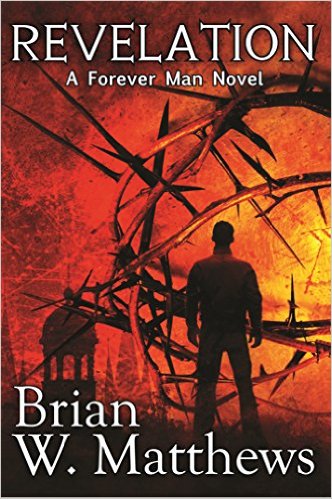
81JdgQmwr2L._UX250_After two books with the same central characters, I wanted to try something different. Forever Man and Revelation are both told in the third person with multiple points-of-view and several flashback sequences. For Conveyance, I wrote in the first person with only one point-of-view, and I limited my use of flashbacks. While this resulted in some limitations in the narrative, I found it exciting to use a different approach to my storytelling. As to the subject matter, I’ve always been interested in blending genres, and I felt combining horror with science fiction would result in a compelling story.

This is your third novel, your first two being part of a series. What lessons have you learned since writing Forever Man? Was this stand-alone novel, The Conveyance, harder or easier to write?
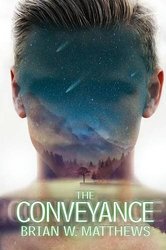
51loH1wnntL._UY250_Probably the biggest lesson I learned from writing Forever Man was my need to trim my descriptions and keep the action flowing. I tend to be overblown in my descriptions of people and places. That dragged down the pace of the story. I blame my insecurity as a new writer: I had to prove to myself that I could “write like a pro.” The problem was, I wasn’t writing like a pro. By the time it came to write Conveyance, I had a better handle on pacing and flow, and I believe it is reflected in the story. As is stands today, Conveyance is a stand alone novel; however, that may change in the future. I left myself a few loopholes where I could squeeze out another book if I deem it is worth writing. Finally, Conveyance was easier to write. I’m more experienced as a writer. I have a greater sense of confidence in my skills. And I’m making far fewer newbie mistakes. All that helps to improve the writing experience for me.

Many authors these days choose to come up with a series of books around one character – what was the appeal for you? Will there be another Forever Man novel in the future?

41p5XF4yiHL._SX329_BO1,204,203,200_The inspiration for the Forever Man series came from two other series of books: F. Paul Wilson’s Repairman Jack novels, and an older fantasy series called The Belgariad, written by the late David Eddings. Both deal with central characters that exist over a span of books, and the latter attempts to humanize what, in that fantasy world, are near-mythical characters. Having a central character like Bart Owens in the Forever Man series gives me a go-to person when an idea strikes. It also allows me to take a break from that character and explore other ideas and storytelling approaches, while leaving the door open for more Forever Man novels.

Tell us a bit about Brian W. Matthews the writer and what he does when he’s not writing?

As a writer, I’m rather quiet. I simply do my job and get on with the next project. I enjoy meeting other writers, hearing them speak about the craft, and generally being part of a wonderful community of thoughtful and generous people. When I’m not writing, I have a day job that keeps the bills paid. I’ve recently remarried, so my wife and I are looking forward to traveling the world over the next few decades. And I enjoy being both a father and step-father. Family is important to me.

Social media is a necessary evil for authors these days. How do you manage self-promotion?

Self-promotion is difficult for me. Being shy, I feel awkward going on Facebook or Twitter to promote my latest work. I almost want to duck under my desk and hide. But in this business, promotion is everything, so I buckle down and ignore those uncomfortable feelings and look at it as part of the job. I have to admit, self-promotion does get easier with time, though I doubt I’ll ever be comfortable with it.

What does horror fiction mean to you as a reader and a writer?
51Vp6jOvazL._SX330_BO1,204,203,200_Horror is more about love than it is about fear. Horror is a mechanism by which writers show how love can overcome so many obstacles. Sometimes that can be lost on readers, or even on writers. For me, I start with loving and caring protagonists, and then I use the horror part to put more and more pressure on them. I get curious about how they will react, what traits end up coming out as strongest. The process fascinates me, and it fascinates me, it may well fascinate a reader. What I think demeans horror fiction the most, I believe, is the horror movie, the “blood for the sake of blood” approach that removes most of what makes great horror fiction great. Truly great horror fiction is so much more than blood and guts.

What’s next for you?

Next up is a third Forever Man novel. I left a massive cliffhanger at the end of Revelation, and it would be unfair to leave readers wondering what’s happening by stepping away from it for too much longer. That will likely be the last Forever Man novel for a while. I have a few other ideas, including dabbling in other genres, that I would like to explore more fully.

Guest post: Lee Murray “At the Edge”

Award-winning author and editor Lee Murray has hijacked my blog to talk about the killer cross-Tasman anthology she edited with Dan Rabarts, At the Edge.

ate

Down here in the Antipodes, we’re all immigrants of sorts. Either pushed or jumped from other lands, our ancestors ‒ some very recently ‒ decided to make the arse-end of the world their home. And that migration has an effect on the way we see things, slightly skew-whiff, because we’re examining the world from its underbelly. We’re not ashamed of our outlook. Not at all. In fact, we’re proud of our quirky perspective. So, when Dan Rabarts and I were contemplating the craziness of another anthology project to follow Baby Teeth, it made sense to us to explore that viewpoint, to look at what it is that makes Australian and New Zealand stories stand out and also stand together. We hoped that the anthology’s theme, At the Edge, would inspire writers to do just that.

So, what did we find?

One of the first things we noted was a focus on the environment, and in homage to that we anchored the anthology with two stories deeply connected to the land and its ability to sustain, opening with Jodi Cleghorn’s The Leaves No Longer Fall in which Annabel and her children live with other refugees amidst the boughs of a Moreton bay fig. They’re safe there for the moment, sequestered from the sun-stricken environment by walls of living glass. But the glass is failing, and now Jackson, Annabel’s dead husband’s brother, has turned up, asking her to go back to the place where she was betrayed, to fix the rot she’d nothing to with.

We closed the collection with AC Buchanan’s And Still The Forests Grow Though We are Gone, the apocalypse comes on slowly, smothering us in isolation, as kelp forests close in day by day. It’s a story of hopelessness and abandonment, relevant perhaps for castaways at the edge of the world.

Then Summer Wigmore tells of a river, a mighty rolling river, which serves as both a barrier and a gateway to something new in Back When the River had No Name, and the queen of disquiet, Shadows Award winner Debbie Cowens, brings us a Lovecraftian tale of inexorable horror purged up in the frills at the edge of the ocean in Hood of Bone.

Then there are the beasts. Carlington Black lulls us into a false sense of security with long balmy summer days where the thrum of cicadas drowns the sound of the kids playing in the back yard while the adults sit back, languid in the heat, and watch the days float by. And if farming news bores the pants off you, then you haven’t read David Steven’s horror gem, Crop Rotation.

Being the first countries to see the sun each day, the lands sitting firmly beneath the Southern Cross, gives us a unique notion of the universe, made clear in AJ Fitzwater’s Splintr, a tale of the last days of the earth as told by its sole witness; a story told in prose that is as sharp as glass. That unique view occurs again in EG Wilson’s 12-36, an Antipodean Firefly if ever there was one. In Richard Barnes’ The Great and true Journey, a group of god-forsaken pilgrims, enhanced or otherwise, strive for an impossible nirvana on the frozen ice plains of Tunga.

My dad always said we were a local call to heaven down here at the bottom of the world and Anthony Panegyres’ supernatural fantasy Crossing, which operates in the thin line between life and death, explores this very notion, as does Tom Dullemond’s gripping futuristic military thriller, One Life, No Respawns. Equally chilling, but quieter in its approach is David Versace’s Seven Excerpts from Season One, where the dead flirt with the living between frames.

There are stories steeped in mythos, plucked from the land itself. JC Hart’s Hope Lies North is one such story. Inspired by the landscape on State Highway 3 near Awakino, it’s a contemporary parable of the earth mother taking back her people. Likewise, in Keira McKenzie’s In Sacrifice We Hope, two boys go in search of an urban legend amid the toxic sludge of wastelands on the outskirts of Perth. Paul Mannering creates a new world that is a startling blend of all things Pasifika in The Island at the End of the World, a story of family and of renewal.

Of course, any anthology from the Antipodes must forcibly include tales about resilience and the indomitable nature of the spirit, the notion that you-can’t-keep-a-good-man down as seen in Martin Livings’ Boxing Day. Or, in the case of Octavia Cade’s Responsibility, you can’t keep-a-dead-chicken-down. Or Joanne Anderton’s Street Furniture, where it’s about girls and goblins and the vagaries of ‘interior’ design. Still others went a step further to explore what happens when the burdens become too much, giving us stories from the edge of madness. Eileen Mueller’s Call of the Sea, Shell Child’s Narco, and AJ Ponder’s chilling contemporary fairy tale, BlindSight are examples.

Finally, the world-building enthusiasts will love the reworking of Arthur C. Clarke finalist, Phil Mann’s, classic tale, The Architect, as well as Jan Goldie’s quirky urban outback tale of retribution Little Thunder.

So what did we learn? Well, we weren’t disappointed. Anything but. Every story in At the Edge, indeed all the stories submitted, had that deeply embedded antipodean spirit we’d been hoping for. They were “infused with that bloody-minded quality that embodies the

Antipodes, a resilience inherent in nations born of warriors and wanderers, the children of whalers, convicts and miners: people not afraid to roll up their sleeves, or strike out for new territories, innovative resourceful sorts prepared to find meaning in the expanses out here at the edge of the world.”

At the Edge, Dan Rabarts and Lee Murray (eds)

DSCN0293

With six pointy Sir Julius Vogel Awards on her bookshelf, and an Australian Shadows trophy in shared custody with co-editor Dan Rabarts, Lee’s most recent work is the military monster thriller Into the Mist (Cohesion Press). The author of several novels, shorts stories and novellas, Lee is proud to be the editor of six fine anthologies of speculative fiction. www.leemurray.info

Dan Rabarts is a multi-award-winning short fiction author and editor, podcast narrator, and sailor of sailing things. He was the recipient of New Zealand’s Sir Julius Vogel Award for Best New Talent in 2014, and the co-editor of Baby Teeth – Bite-sized Tales of Terror, with Lee Murray, which won the SJV for Best Collected Work and the Australian Shadows Award for Best Edited Work that same year. Dan and Lee continue to collaborate on projects, including a crime-horror novel set in a dystopian near-future Auckland. His SFFH short stories have appeared in venues such as Beneath Ceaseless Skies, Andromeda Spaceways Inflight Magazine, and Aurealis, on the Hugo award-winning podcast StarShipSofa and others, and in the anthologies Regeneration, In Sunshine Bright and Darkness Deep, and The Mammoth Book of Dieselpunk, to name a few. He is one head of the writing band Cerberus, which includes fellow kiwi author Grant Stone and a certain hairy mango, Matthew Sanborn Smith. Find out more at www.dan.rabarts.com.

The Happening(s)…

No, it’s not the M. Night Shyamalan movie (thank the gods)

But 2016 is shaping up to be a very busy year for me (despite the odd spanner in the works). Here’s a few exciting things in the pipeline.

Torment novella re-release from Lycan Valley Press.

Here’s the new covert art I designed!

torment-cover

The book will be available in digital, paperback and hardback in July. The print versions will also include five (5) internal illustrations by yours truly.

Originally released in 2011, I’m very excited to see my first novella in print again.

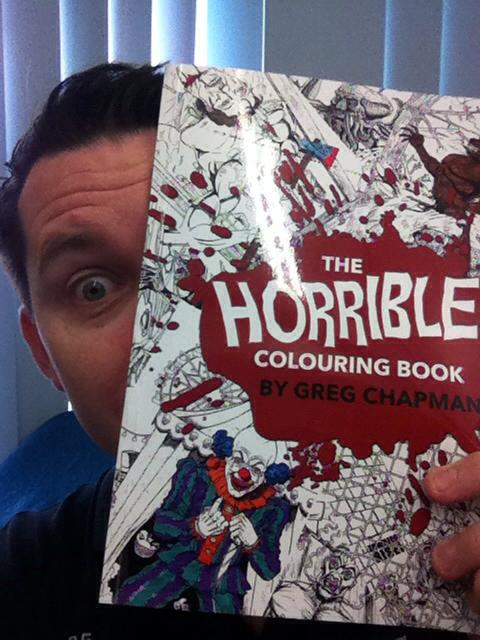
Meanwhile, my new colouring book, The Horrible Colouring Book, will be available soon.

Sold exclusively through the CQUniversity Bookshop, which handles book distribution around the world every day, this volume features a brand new cover, and a far superior level of print quality. Links on how to buy, including the cost, will be released soon! Some pics of me with a proof are below:

13524484_10210007873783815_588002914326947591_n

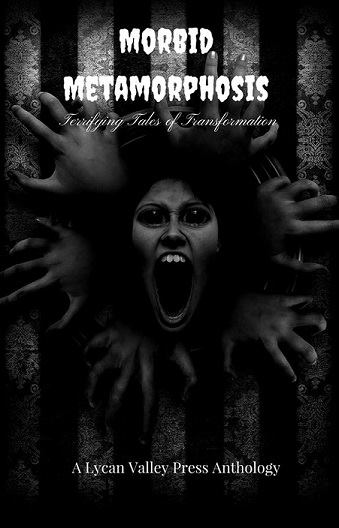
Also I recently had a short story, published in this killer new anthology, Morbid Metamorphosis, from Lycan Valley Press. I’m very honoured to be one of 5 Aussies in this antho, which is already soaring up the Amazon booklists! You can pick up an ebook copy HERE or a print copy HERE .

13445393_1101349746570925_7734657474240367894_n

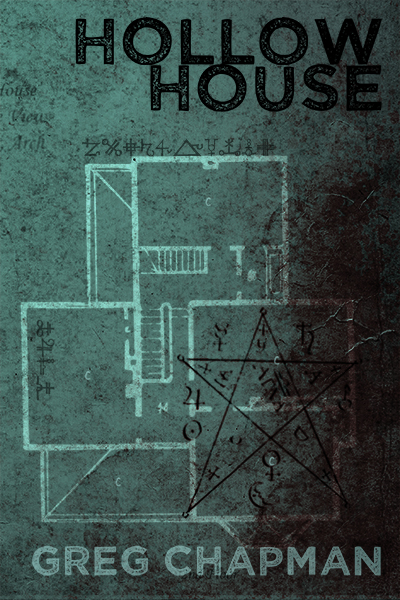
and finally, it’s a month out from the release of my debut novel, Hollow House through Omnium Gatherum Media in the US.

Hollow House WS

In anticipation of the release, I’m inviting anyone who would be interested in reading an advanced reader’s copy in exchange for an honest review to check out this Goodreads LINK.

The only downer I’ve had is a T-shirt bootleg company stealing my art, but that’s another story!

Talk soon and keep on screaming on!

Horror – food for thought, or just mindless entertainment?

Controversial opinion:

Horror fiction should make you think rather than purely entertain.

Not to say that horror fiction can’t be action-packed, but to me horror fiction’s strength comes from its exploration of psychology. I love to create flawed characters and take readers inside their heads. I also love taking moral questions and twisting them until they bleed. Isn’t that what horror fiction should be?

skull-thinkerBut recently I’ve come to realise that the majority of readers don’t necessarily want this kind of fiction. They prefer explosions with titbits of humour rather than quiet horror, or dark mysteries. Or am I wrong? I don’t know.

Another thing I’ve noticed is that people’s personal prejudices, or concerns that others’ sensibilities might be offended, will turn them off stories. One reviewer I’d sent my novella The Eschatologist to turned it down because they perceived a religious bent. If anything the book is anti-religious! Why not judge the story by the story?

As a writer – and a reader – I’m more drawn to tales that leave you asking questions after you’ve reached the final page. Being indoctrinated towards authors like Barker and Poe naturally I’m going to lean that way, but still, I feel I might be in the minority here. Having said all that, I don’t want to come up with a happy blend of entertaining, but still horrific fiction, just to garner a few more readers. I’d be compromising my own integrity, wouldn’t I?

I recently discussed all this with an author friend who said that after reading my work it left them feeling ‘heavy’ and that maybe there was too much darkness in there. I’ll take that as a compliment 🙂 Another author recently posted on Facebook their concern that they’d killed off all their characters in one story, but their concern was more about becoming predictable.  Still it’s a horror story – and it’s their story. Should they really be concerned about reader expectations, or just telling the best story they can?

Maybe I’m just thinking out loud, or whinging? Or maybe people just don’t care about reading anymore. Horror tastes are different for everyone, whether it be films, fiction or merchandise, but should creators and writers try and fit a particular mold? Maybe I’m overthinking it?

I think I’ll just stick to writing fiction 🙂 but I’d love to hear your thoughts.


Hollow House cover reveal!

***UPDATE: HOLLOW HOUSE TO BE PUBLISHED 25 JULY, 2016!***

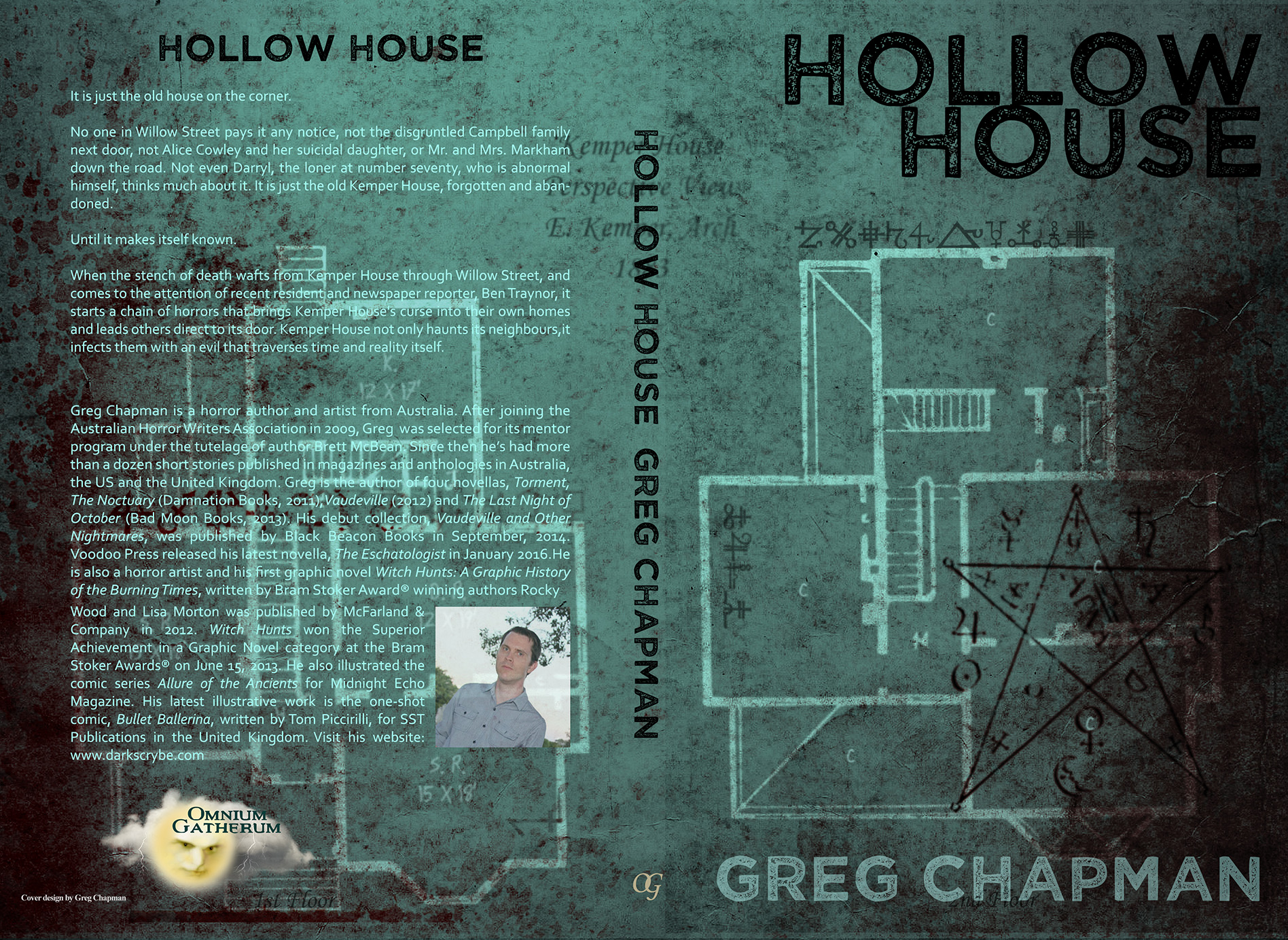
The plans for Hollow House have been unveiled with the release of the cover art for my debut novel!

Hollow House Full Cover-small

I put the wraparound art together with feedback from Omnium Gatherum publisher, Kate Jonez. We’re both really happy with how it turned out. It’s creepy and contemporary.

Things are progressing really quickly with not just the cover art, but an advanced reader copy is expected to be ready for reviewers by the end of May. I’d very much like to thank my editor Janet J Holden, who has been working hard to finish off edits on the novel.

I’ve also managed to entice three award-winning authors to read an ARC of the novel with the possibility of providing a testimonial. The very thought of this trio reading my book, let alone providing a blurb for it, makes me very nervous. As this will be my debut novel, I can’t help but worry, but with everything going so smoothly, I feel that a fair bit of good luck is on my side.

Hollow House is expected to be published by Omnium Gatherum in paperback and digital formats in October. For more information, visit OG’s website.

“The Bone Maiden” a finalist in the Australian Shadows Awards

Some pretty cool news today with the my short story, “The Bone Maiden”, named as a finalist in the 2015 Australian Shadows Awards, short fiction category!

Shadows Awards put Australian writers in the spotlight

I’m sharing nominee space some very cool authors and friends, including Martin Livings, Pandora Hope, Deborah Sheldon and Kaaron Warren.

The Bone Maiden is a dark fairy tale, which was selected by editor Sophie Yorkston for SQ Mag #20 back in May last year.

cover-sq-mag-20 (1)

You can read The Bone Maiden for free in SQ Mag HERE!

The Shadows Awards are hosted annually by the Australian Horror Writers Association. I was also a judge this year for the graphic novel category.

I urge you all to congratulate and check out the full list of finalists in all the categories because they all deserve to be read! Here’s the official press release:

Australian Shadows Awards

The Australian Horror Writers Association is excited to announce the shortlisted finalists for the 2015 Australian Shadows Awards. These works represent the best in Australian and New Zealand horror published in 2015.

The Australian Shadows awards are the only Australian award dedicated solely to the very best in horror fiction, non-fiction and graphic novels and recognise those works that crawl under your skin and linger long after the final pages.

Our volunteer judges have worked tirelessly to work through hundreds of entries and made some tough decisions to narrow it down to the final shortlists. The Association would like to extend our congratulations to those who have made it this far and thank those that who entered works in this year’s awards.

Winners will be announced via a Facebook awards ceremony on Friday, April 22 at 8pm (AEST).

The shortlisted works are

The Paul Haines Award for Long Fiction

In Vaulted Halls Entombed – Alan Baxter

The Haunting of Gillespie House – Darcy Coates

Night Shift – Dirk Flinthart

The Whimper – Robert Hood

Edited Works

Bloodlines – Amanda Pillar

Lighthouses – Cameron Trost

Midnight Echo 11 – Kaaron Warren

Blurring the Line – Marty Young

Collected Works

The Abandonment of Grace and Everything After – Shane Jiraiya Cummings

Peripheral Visions: The Collected Ghost Stories – Rob Hood

Cherry Crow Children – Deborah Kalin

Short Fiction

The Bone Maiden – Greg Chapman

Eight Seconds – Pandora Hope

El Caballo Muerte – Martin Livings

Perfect Little Stitches – Deborah Sheldon

Mine Intercom – Kaaron Warren

Comics/Graphic Novels

The Road to Golgotha – G.N. Braun & Amanda J Spedding

Troll – Michael Michalandos

The Monster – Ben Rosenthal

Undad – Shane W. Smith

The Rocky Wood Award for Non-fiction and Criticism

Winner to be announced

Novels:

The Catacombs – Jeremy Bates

The Haunting of Blackwood House – Darcy Coates

The Transgressions Cycle: The Mothers – Mike Jones

The Transgressions Cycle: The Reparation – Mike Jones

The Big Smoke – Jason Nahrung

Novella “Torment” to be re-released by Lycan Valley Press

Some further good news is that Canadian press, Lycan Valley Press will be re-publishing a new illustrated edition of my first novella, Torment this year!

lvp

Originally published in 2011, Torment is a creepy supernatural tale, blending together the exorcism and haunted house sub-genres.

Here’s the blurb:

Jessica Newman’s tragic childhood has come back to haunt her. Her father, a Catholic deacon she hasn’t seen since he was found not guilty of her mother’s death during an exorcism ritual, has turned up dead in Scotland, with a wound to the head. Forced to take her family to Scotland and deal with her father’s estate a derelict mansion in the Grampian Ranges, Jessica begins to question her mother’s death and what role her father played in it. The house and its dark basement could provide more answers than she bargained for.

I’m really excited to see this story more widely read, and LVP seem really dedicated to make the paperback edition something special.  Here’s LVP’s announcement

LVP also recently accepted my short story, “Become Him”, to appear in their debut anthology, Morbid Metamorphosis.

More details on Torment and the anthology as they come to hand.

Debut novel, “Hollow House” to be published by Omnium Gatherum!

Some huge news this week as I officially singed on with Omnium Gatherum Media to publish what will be my debut novel, Hollow House.

Putting this novel together was a mammoth task, but I’m very excited that it’s found a home with Omnium Gatherum, a well-respected and growing small press based in California, USA.

download

I don’t want to give too much away about the novel just yet, but as the title implies, it’s a haunted house story, but I’ve aimed to turn the sub-genre on its head by telling the house’s story from the outside looking in, rather than the other way around.

It’s a dark, dread-filled story that will centre on the characters living in the same street as the house and how they will slowly be corrupted by its evil presence.

Hollow House is expected to be released in paperback and digital formats later this year.

Further details on the announcement can be found on the Omnium Gatherum website HERE

The Eschatologist now in paperback!

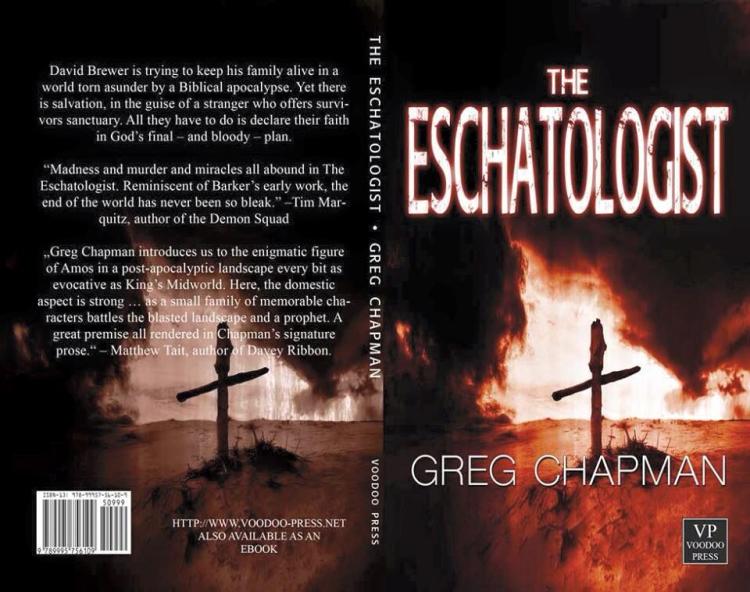
The print edition of my post-apocalyptic horror novella, The Eschatologist is now available.

eschatologist-paperback-cover

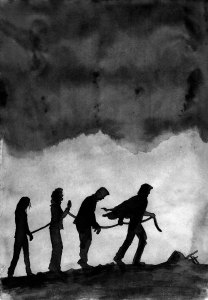
eschatologist3-smallThe paperback includes four black and white illustrations I created especially for this edition.

Released in January from Voodoo Press, The Eschatologist tells the story of David Brewer who is trying to keep his family alive in a world torn apart by a Biblical apocalypse. But there is hope is the guise of a mysterious saviour named Amos, who promises them sanctuary – in return for their devotion to God’s final and bloody plan.

Since being released in January, The Eschatologist has received several favourable reviews:

Greg Chapman opens the story with a gripping opening line, “The after-world was a canvas of ashen ruin painted by death.”

What follows is a story of family, sacrifice, and the scary idea that even in a world that has completely fallen apart there will always be a lunatic fringe.

You can read more of this review here – http://frankmichaelserrington.blogspot.com.au/2016/01/the-eschatologist-by-greg-chapman.html

Greg Chapman introduces us to the enigmatic figure of Amos in a post-apocalyptic landscape every bit as evocative as King’s Midworld. Here, the domestic aspect is strong … as a small family of memorable characters battles the blasted landscape and a prophet. A great premise all rendered in Chapman’s signature prose. – Matthew Tait, author of Davey Ribbon.

“Madness and murder and miracles all abound in The Eschatologist. Reminiscent of Barker’s early work, the end of the world has never been so bleak.” –Tim Marquitz, author of The Demon Squad

Available now in paperback from Amazon

DARKSCRYBE.COM

Stay informed with curated content and the latest headlines, all delivered straight to your inbox. Subscribe now to stay ahead and never miss a beat!

Skip to content ↓